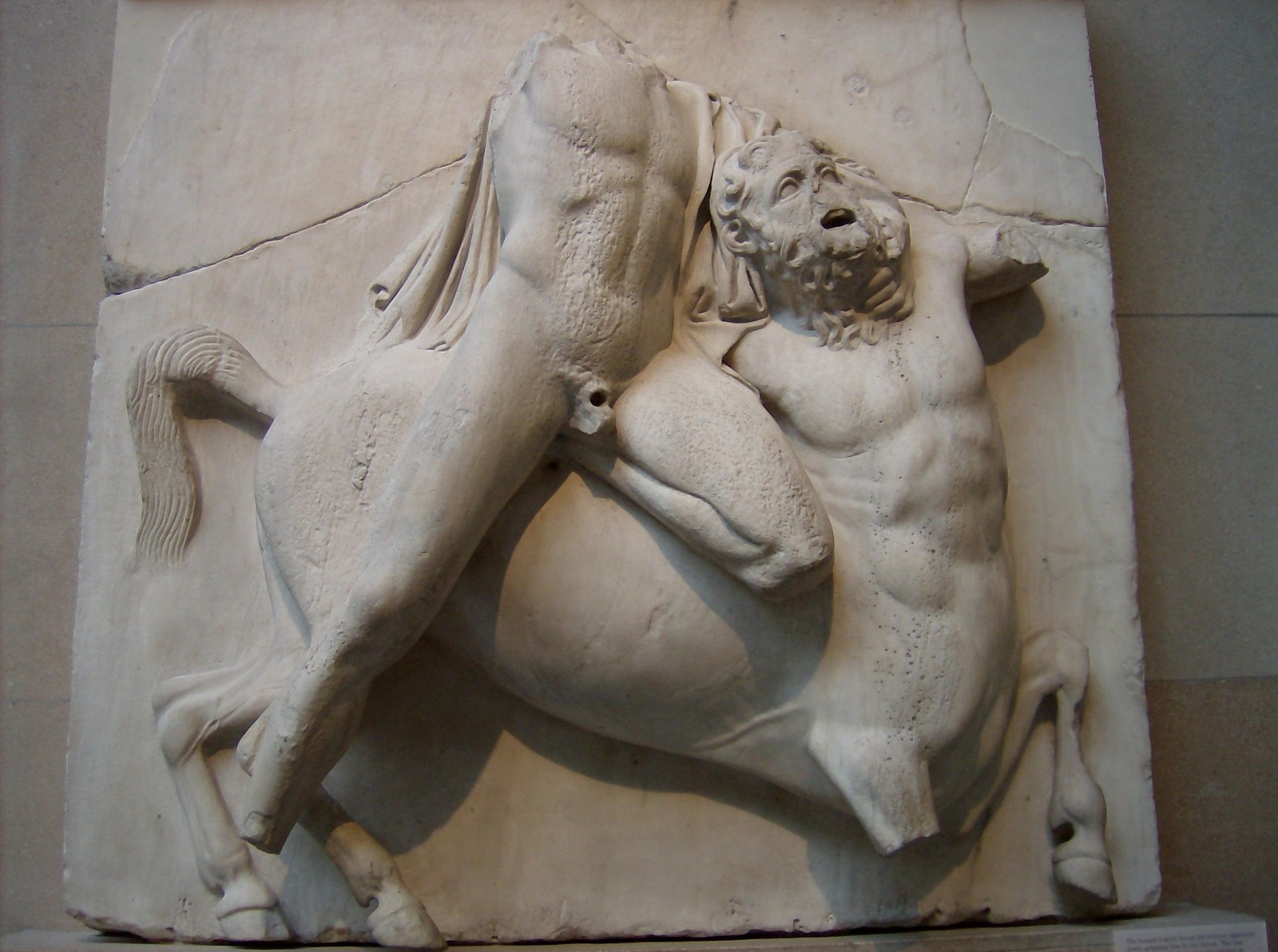
I am a self-confessed reluctant centaur.
In Greek mythology, centaurs were creatures at the edge of humanity, uncivilized to an ancient Greek. Half horse, half human, they were wild and untamed, living on the fringes of the civilized Greek world.
As a technological metaphor, the centaur is a human assisted by a machine (Doctorow, 8). We use a car, for example, to transport ourselves and our goods, but it is (at least for the moment) the human driver who is very much in control of the car. The driver decides where to go, how to get there, and makes millions of little decisions in regard to safety on the road. If the car is speeding, it’s not the car that is charged with breaking the law—it is the driver, who is making the car speed that is held responsible. The human makes the choices about how to use the technology.
A reverse centaur, on the other hand, is technology that drives the human. The human is no longer in control of the technology and does not use the technology. Rather, the human is the assistant to the machine (9). The reverse centaur is the Amazon warehouse, where workers are “conscripted to serve as peripherals for the warehouses automation systems” (10). Humans do not have a choice about how to use the automated technology.[1]

The metaphor is apt. Our human engagement with technology pushes at the boundaries of our known humanity, promising to extend what we are capable of. The technological future is a wild, unknown space we explore through science fiction stories, a space of amazing eutopias or the most depressing dystopias that either embellish or diminish our human capacity for compassion, empathy, and all the soft things that make us vulnerable humans.
The reluctant aspect comes in with my “wait and see” approach to new technologies.
When generative AI emerged with much fanfare in 2020, I didn’t rush in. The hype alone made me wary, and that wariness was reinforced by my academic environment. Those in my academic circles seemed to fall into one of two camps: Enthusiastic embrace of a new, future-forward way of doing things more easily, or the opposite, that AI was a complete anathema, destroying humans’ ability to think and express themselves (and, probably, society itself).
As with most things, I suspected that the reality lay somewhere between the two poles, and thus my caution over enthusiastically joining in on the ChatGPT hype, and even resistance as tech keep forcing AI into every conceivable app I use. As the financial, environmental, and thinking costs of AI have emerged, the public sentiment seems to be turning against the AI hype. Perhaps there was something to my gut reaction.
I have been low-key trying to avoid the AI question in my podcasting practice. AI tools have proliferated in the podcasting space and while I can see legitimate use for it in some things, like transcription or audio editing, I struggle to appreciate any benefits to generating podcasts completely with AI. Whether podcasters are pro- or anti-AI, the strength of opinions expressed is often quite strong and honestly, I don’t enjoy those kinds of debates.
However, my internship this summer forced me to grapple with the AI question more directly. Using AI in the workplace was a new experience—and I found AI very seductive. I could see first-hand how generative AI allowed entrepreneurs and businesses to move at a much faster pace—and moving at a faster pace was required to keep up with business. I spent hours with Calliope, my ChatGPT assistant, using her to analyze voice and vocabulary, to turn a handful of source documents into a variety of fancy-looking documents in my client’s voice.[2] She made a great concordance and indexing tool to locate quotations and themes in a book-length documents. I spent time training her on my work to help me identify my own writing voice and move my public-facing writing from very academic to something (hopefully) more accessible to my audience. It was wonderful.
But I was torn. I saw how much easier it made everything when I didn’t need to start each endeavour from complete scratch, but I was keenly aware of the environmental and economic costs, at least as they are presented in the media. There are no bonus points for doing life in hard mode, but what are the costs of easy mode and how much individual responsibility do I bear? I worried that using it would diminish my own reasoning and creative abilities. I don’t want my writing or my podcast to sound like everybody else’s AI generated writing—vague, bland pablum that doesn’t really say much. [3]
With this mental conflict, it was balm to stumble across an interview with author Cory Doctorow on CBC radio (Day Six). By the time I heard a second interview with him by On the Media, I was eager to read his book, The Reverse Centaur’s Guide to Life After AI (MCD, 2026).
Doctorow’s book feels like a calming balm. Amid contentious debates about the use of generative AI, Doctorow offers an Aristotelian golden mean between two opposing poles. In accessible language, he escorts the reader, calmy and clearly, through the economic and environmental issues presented by pro- and anti- AI parties. He provides a nuanced analysis beyond the media hype, distinguishing between the AI hype and the technology itself.
He argues that we need to understand the nuances of the technology itself and the current AI bubble hype so we can make wise, informed decisions about how it impacts our society. Ultimately, Doctorow argues that we approach AI as a tool, much as we now use spellcheck or calculators without moral quandry.
As a humanist, the impact of AI on the arts is of particular interest to me. The proliferation of AI slop in video and graphics has been depressing. But Doctorow offers hope. Human creativity does not win out over AI by arguing about copyright or losing jobs. Rather, we preserve our society’s capacity for creativity by recognizing that the real question is one about the control of labour.
Doctorow approaches art as a communicative act (93). Art, he says, “is what happens when an artist has a big, numinous, irreducibly complex feeling in their mind, which they infuse into some artistic medium…in the hopes of making a facsimile of that… feeling materialize in the minds of the people who experience their art” (92-93). My definition of art, of course, includes podcasting, and it’s easy to understand a podcast as a communicative act. But paintings, abstract art, interpretive dance, memes, and gifs are also communicative acts.
You can probably see the problem already: AI isn’t human, it doesn’t have big complex feelings to communicate (102). It’s a “statistical word-guessing program” (98). That is why AI art, whatever its form, falls flat: It’s not good art because it doesn’t communicate much (97). Doctorow uses the example of a reference letter generated by AI. While AI can create the form of a student’s reference letter, it can’t add information beyond what it is given in the prompt. The AI prompt itself is the only communicative act, not the resulting text or image (99).
This is why AI generated art seems so eerie and soulless. Art convey something meaningful an intentional way (100-101). When a human creates a painting, each brushstroke is intentional and conveys meaning. As humans looking at art, we have never encountered brush strokes that were not intentional (100). AI creates the look of the brush strokes, but there is no intent to them. Thus, the strokes lose their meaning (100). When we look at an AI image, we expect to find intention in the brushstrokes we see, but it’s not there. We are trying to ascribe meaning where there is none, and this is eerie.
This leaves us with a choice: do we humans adapt to the AI art and train ourselves not to look for intent and communication in the brushstrokes? Or do we reject its emptiness and preserve the messiness of human communication? I think we are already seeing a rejection of non-communicative AI “art.” Movie directors are rejecting AI slop. Gen Z are pushing back against it. College grads have been booing AI industry speakers at convocations. Canadian and American artists, particularly commercial artists, graphic designers and concept artists in entertainment, having been raising the alarm of what AI may do to their jobs and industries. Authors and their readers, musicians and their listeners, all seem to be rejecting the intrusion of AI in the arts in favour of genuine human connection. Publishers and authors are leveraging US copyright law in their fight against AI companies with some success.
Intuitively, copyright law seems to be a logical, legal way to curb the production of AI slop. But Doctorow argues that preserving human intent and creativity in communication doesn’t lie in the copyright argument as it currently exists. The fight for the human-headed centaur will not be won by arguing over who gets to scrape from which sources. In fact, Doctorow argues, the copyright law doesn’t protect artists in the ways we think it does. Rather, he reframes the debate over AI and creativity as a debate about labour and economic resources.

AI is being sold to bosses as a way to control resources and labour. Lower labour costs are AI’s underlying value proposition (105). Regardless of whether the AI can do what its salespeople claim (and it can’t), it is being sold as a way to eliminate human wages and control product outputs. The AI companies are only interested how they can make money from AI, and the way do is by selling it others. A bad used car salesman doesn’t really care if he’s selling you a lemon, he just wants the sale. He doesn’t need the car to work; He just needs to convince you it works.
When creative jobs are threatened, the long-term answer isn’t to argue that AI is violating copyright by training on creative work. Rather, as creators and consumers of the arts, we need to recognize that copyright law is about the control of creative labour. Copyright controls who can do what with a piece of creative work and thus make money from it. The media conglomerates and private equity firms are attempting to extract as much wealth as they can from the creative labourers in their employ (141) and are extremely hawkish about their copyright. Ever tried to use Disney music in a YouTube video? You can’t, because Disney doesn’t want you to profit off a product they own.
Copyright is strictly reserved for human works, and this gives human creators more power than they might think (142). The human-generated prompt put into AI can be copyrighted, but the AI output itself can never be copyrighted (143). This means that AI work is public domain and belongs to everyone. It cannot be owned by an individual human or a corporation. Any product a company brings to market that is generated by AI cannot be controlled by that company. A few human adjustments to an AI generated piece are not enough to attain copyright. The bosses do not own the product their AI has produced (144), severely curtailing their ability to control and profit from it in the marketplace. If they don’t own it, they can’t profit from controlling access to it.
As creatives, our discussion of AI and copyright needs to focus on preserving copyright for human generated work. This, Doctorow argues, rather than trying to expand copyright law, is what will preserve creative jobs and keep the human head on the centaur (146). This approach lets the human creative use AI tools to the drudge work—for example, de-hissing tape or removing background noise (147). AI becomes another “normal technology” tool in the toolbox for creatives to use, rather than an excuse for bosses to fire all the humans.
“That’s the future that centaurs should want: one where we, the workers, control the means of production, and where policy does not encourage our bosses to fire our asses and replace us with chatbots.” (147)

The current AI bubble will pop. It will not be pleasant financially: Seven AI companies account for 35% of the US Stock market, so many innocent bystanders will be destroyed in the implosion (202). We, the ordinary citizens, will be left to pick through the residue—physical and metaphorical—of the AI bubble and determine what we can reuse.
And we will have paid a very enormous cost for that residue. Every iteration of AI has been more expensive than the last (200). It won’t be just the AI companies paying that cost. AI can’t replace human labour, but the AI salespeople who convince bosses it can will cost many people their jobs (61, 65). Massive data centres are being forced on communities despite their protests. Those data centres consume enormous resources—not just electricity and water, but the conflict minerals used to make their hardware and the energy consumption and pollution from the process (200). Billions of hours of human labour have been put into training AI models (198) in a perverse race to extract maximum individual wealth at all costs.
“If we are good AI critics, if we carefully identify the pathological aspects of the AI bubble, we can make sure that all the terrible things billionaires want to do with AI never happen, and we can consign all the terrible things that are currently being done with AI to history’s ash heap.” (213)
Doctorow ends on a hopeful note: We still have time to pop the bubble before it gets worse. We can unmask the Mechanical Turk and understand what AI really does, and doesn’t, do. We can stay as the human-headed centaur, adapting and using this technology like all the ones before it. But to do so, we need to move away from the hype, we need to understand the nuances, and we need to become careful AI critics.
[1] The centaur/reverse-centaur metaphor reflects the social determinism and technological determinism models for thinking about technology or Rushkoff’s figure and ground approach to digital media. Ultimately, they all ask the same question: who is in charge, the human or the technology?
[2] Yes, I realize there are issues with anthropomorphizing and gendering assistive technologies. At the end of the day, I am human and not above such things.
[3] See, for example, the recent controversy over Hank Green’s use of AI in creating his videos and the influence it has had on his own writing voice.


Leave a Reply