
Episode 11: (Re)Covering Bad Women– From Ithaka to Whitechapel
This episode is the second in “(Re)Covering Bad Women,” a podcast miniseries exploring vulnerability, precarity, and victimization in true crime podcasts. This episode is an explanation of my creative podcast episode, (Re)Covering Bad Women: Unruly Slave Girls in the Odyssey. This episode connects the creative sound piece to broader themes from Emily Wilson’s translation of Homer’s Odyssey and Hallie Rubenheld’s podcast “Bad Women: The Ripper Retold.”
Content warning: While I avoid graphic descriptions, this podcast does address themes of rape, murder, and slavery in Homer’s Odyssey, and connects those themes to true crime.
Sources
Butler, Judith. Frames of War: When Is Life Grievable? Verso, 2016.
DuBois, Page. Slaves and Other Objects. University of Chicago Press, 2003.
Fogh, Julie, and Casey Clarke. “The Frying Game: On Vocal Fry and Sexist Feedback.” Vital Voice Training. Accessed 9 Oct. 2025. Website.
Fulkerson, Laurel. “Epic Ways of Killing a Woman: Gender and Transgression in ‘Odyssey’ 22.465-72.” The Classical Journal, vol. 97, no. 4, 2002, pp. 335–50.
Higgins, Charlotte. “Epic Win: Why the Odyssey Is Having a Moment.” The Guardian, 12 Apr. 2025. Books. The Guardian, .
Homer. The Odyssey. Translated by Emily Wilson, Norton, 2018.
Innes, Alison and Darrin Sunstrum. MythTake. Podcast.
Katz, Marylin. Penelope’s Renown. Princeton University Press, 1991.
Loraux, Nicole. Tragic Ways of Killing a Woman. Harvard University Press, 1987.
Mulvey, Laura. “Visual Pleasure and Narrative Cinema.” Film Theory and Criticism: Introductory Readings, Oxford University Press, 1999, pp. 833–44.
North, Anna. “Historically, Men Translated the Odyssey. Here’s What Happened When a Woman Took the Job.” Vox, 20 Nov. 2017.
Rubenheld, Hallie. The Five. Penguin, 2019.
Rubenhold, Hallie, and Alice Fiennes. Bad Women: The Ripper Retold. Podcast.
Schneider, Hauke. “The ideology of seafaring in the Odyssey and Telemachos’ hanging of the slave girls,” in Mediterranean Connections. Vol. 18. Ed. Anja Rutter, Laura C. Schmidt, Laura C , and Lutz KäppelVol. pp. 171-186. Sidestone Press, 2023.
Storr, Will. The Science of Storytelling. Abrams Press, 2020.
Santos, Cristina. Untaming Girlhoods: Storytelling Female Adolescence. Routledge, 2023.
Traister, Rebecca. Good and Mad: The Revolutionary Power of Women’s Anger. Simon & Schuster, 2018.
Wilson, Emily. “Slaves and Sex in the Odyssey.” Slavery and Sexuality in Classical Antiquity, University of Wisconsin Press, 2021, pp. 15–39..
———. “The Odyssey.” Emily Wilson. Accessed 16 Oct. 2025. Website.
Wright, Jeff. Trojan War: The Podcast. Podcast.
Credits
Project PhDcast is created, hosted, and produced by Alison Innes. Music is “Grand Dark Waltz” by Kevin McLeod (incomptech.com) and is used under Creative Commons license.
View this podcast with subtitles on YouTube. Transcripts available for download by request.
Share your thoughts:
- Visit my website https://podcastologist.ca/contact
- Email podcastinghumanities@gmail.com
- Learn more about this research project and how you can participate by visiting https://podcastologist.ca
Project PhDcast is an ongoing project by Alison Innes, PhD student in Interdisciplinary Humanities at Brock University. This research project has been approved by the Research Ethics Board at Brock University, file #23-020-MAURO.

Episode 10: (Re)Covering Bad Women– Unruly Slaves in the Odyssey
This episode of Project PhDcast is part one of (Re)Covering Bad Women, a podcast miniseries exploring vulnerability, precarity, and victimization in true crime podcasting. The first part of (Re)Covering Bad Women is a creative sound piece based on the story of the enslaved girls in Homer’s Odyssey, with passages taken from Emily Wilson’s translation and read by Darrin Sunstrum.
Sources
Homer. The Odyssey. Translated by Emily Wilson, Norton, 2018.
- Book 1.108-112 / p. 108
- Book 1.436-440 / p. 119
- Book 17. 88-95 / p. 389
- Book 18.318-326 / p. 419
- Book 19.385-392 / p. 437
- Book 20.7-9 / p. 445
- Book 20.105-112 / p. 449
- Book 20.158-162 / p. 450
- Book 22. 446-460 / p. 491
Credits
Project PhDcast is created, hosted, and produced by Alison Innes. Music is “Grand Dark Waltz” by Kevin McLeod (incomptech.com) and is used under Creative Commons license.
View this podcast with subtitles on YouTube. Transcripts available for download by request.
Share your thoughts:
- Visit my website https://podcastologist.ca/contact
- Email podcastinghumanities@gmail.com
- Learn more about this research project and how you can participate by visiting https://podcastologist.ca
Project PhDcast is an ongoing project by Alison Innes, PhD student in Interdisciplinary Humanities at Brock University. This research project has been approved by the Research Ethics Board at Brock University, file #23-020-MAURO.
Episode 09: An Autumn Walk in the Woods
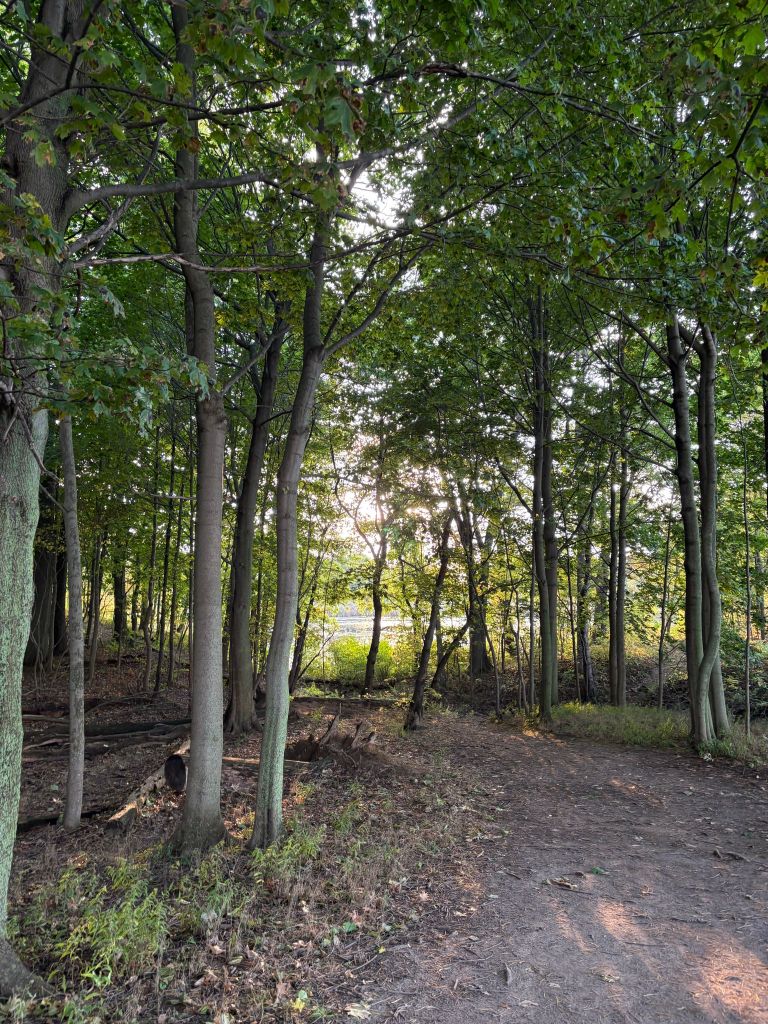
Happy Thanksgiving! It’s a lovely, golden afternoon in October. The woods are fragrant with fallen leaves. A passing thunderstorm has stirred up the waves on Lake Ontario. Birds flit from branch to branch, crickets chirp, and a flock of geese pass overhead. Won’t you join me for an autumn walk in the woods?
For optimal listening experience, please listen with headphones.
Recorded on location by Alison Innes in Niagara, Ontario.
Credits
Project PhDcast is created, hosted, and produced by Alison Innes. Music is “Grand Dark Waltz” by Kevin McLeod (incomptech.com) and is used under Creative Commons license.
View this podcast with subtitles on YouTube. Transcripts available for download by request.
Share your thoughts:
- Visit my website https://podcastologist.ca/contact
- Email podcastinghumanities@gmail.com
- Learn more about this research project and how you can participate by visiting https://podcastologist.ca
Project PhDcast is an ongoing project by Alison Innes, PhD student in Interdisciplinary Humanities at Brock University. This research project has been approved by the Research Ethics Board at Brock University, file #23-020-MAURO.
Episode 08: Here’s to Punk Podcasting
What does a podcast sound like? What should a podcast sound like? In today’s episode I review three of my recent readings about podcasting sound– an academic text on sonic aesthetics, a news article on AI podcasts, and a blog post on punk rock– and how these are shaping my podcast practice and research.
*Contains adult language.*
Contents
- Introduction (00:05)
- The sonic aesthetics of podcasting (02:40)
- AI generated history podcasts (21:25)
- Punk rock podcasting (27:30)
- Credits (32:45)
Sources
Jeremy Wade Morris. 2024. “Podcasting.” Polity Press.
Benjamin Lorch. 2025. “The Power of Punk Rock Podcasting.” Hindenburg.
Credits
Project PhDcast is created, hosted, and produced by Alison Innes. Music is “Grand Dark Waltz” by Kevin McLeod (incomptech.com) and is used under Creative Commons license.
View this podcast with subtitles on YouTube. Transcripts available for download by request.
Share your thoughts:
- Visit my website https://podcastologist.ca/contact
- Email podcastinghumanities@gmail.com
- Learn more about this research project and how you can participate by visiting https://podcastologist.ca
Project PhDcast is an ongoing project by Alison Innes, PhD student in Interdisciplinary Humanities at Brock University. This research project has been approved by the Research Ethics Board at Brock University, file #23-020-MAURO.
Episode 07 Theories & Methods: Humanities Podcasting & Public Discourse
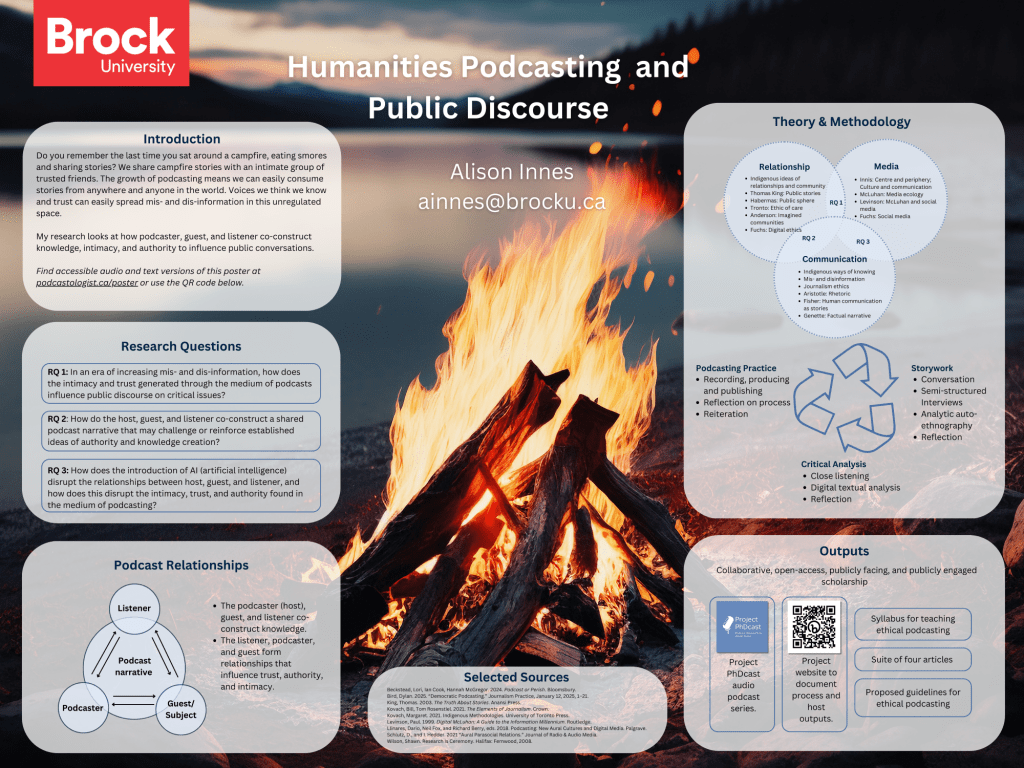
This post is an accessible version of my research poster for the HUMA 7P02 poster session held at Brock University on 2 April 2025.
Do you remember the last time you sat around a campfire, eating smores and sharing stories? We share campfire stories with an intimate group of trusted friends. The growth of podcasting means we can easily consume stories from anywhere and anyone in the world. Voices we think we know and trust can easily spread mis- and dis-information in this unregulated space.
My research looks at how podcaster, guest, and listener co-construct knowledge, intimacy, and authority to influence public conversations.
Research Questions
RQ 1: In an era of increasing mis- and dis-information, how does the intimacy and trust generated through the medium of podcasts influence public discourse on critical issues?
RQ 2: How do the host, guest, and listener co-construct a shared podcast narrative that may challenge or reinforce established ideas of authority and knowledge creation?
RQ 3: How does the introduction of AI (artificial intelligence) disrupt the relationships between host, guest, and listener, and how does this disrupt the intimacy, trust, and authority found in the medium of podcasting?
Podcasting Relationships
My diagram will map how the the listener, podcaster, and guest co-construct knowledge that may either challenge or reinforce established beliefs. This will take into consideration how intimacy, trust, and authority are constructed in these parasocial relationships and how the unequal power dynamics might shape a particular narrative.
Theories
Relationships
- Indigenous ideas of relationships and community
- Thomas King: Public stories
- Habermas: Public sphere
- Tronto: Ethic of care
- Anderson: Imagined communities
- Fuchs: Digital ethics
Communication
- Indigenous ways of knowing
- Mis- and disinformation
- Journalism ethics
- Aristotle: Rhetoric
- Fisher: Human communication as stories
- Genette: Factual narrative
Media
- Innis: Centre and periphery; Culture and communication
- McLuhan: Media ecology
- Levinson: McLuhan and social media
- Fuchs: Social media
Methodologies
Storywork
Drawing on Indigenous methodologies, I will go beyond formal interviews to engage reflectively with fellow Humanities podcasters. By using a relational approach, my research will be formed by and contribute back to the podcasting community.
Podcasting Practice
I will use my podcast as an open source critical autoethnography. I will document my experiences, share my storywork, and mobilize my research in real time. My practice will be informed by my research and will also help identify new and interesting problems.
Critical Analysis
I will use close listening and digital text analysis tools on selected podcasts to critically analyze podcast discourse. This analysis will consider how a particular podcast might influence, or be influenced by, public discourse.
Outcomes
I will create open-access, publicly facing, and publicly engaged scholarship that collaborates with, responds to, and supports the development of the indie podcasting community while expanding the field of podcast studies.
- Proposed guidelines for ethical podcasting
- Syllabus for teaching ethical podcasting
- Suite of four articles
- Project website to document process and host outputs
- Podcast series to document research process and outcomes
Selected Sources
Beckstead, Lori, Ian Cook, Hannah McGregor. 2024. Podcast or Perish. Bloomsbury.
Bird, Dylan. 2025. “Democratic Podcasting.” Journalism Practice, January 12, 2025, 1–21.
King, Thomas. 2003. The Truth About Stories. Anansi Press.
Kovach, Bill, Tom Rosenstiel. 2021. The Elements of Journalism. Crown.
Kovach, Margaret. 2021. Indigenous Methodologies. University of Toronto Press.
Levinson, Paul. 1999. Digital McLuhan: A Guide to the Information Millennium. Routledge.
Llinares, Dario, Neil Fox, and Richard Berry, eds. 2018. Podcasting: New Aural Cultures and Digital Media. Palgrave.
Schlutz, D., and I. Hedder. 2021 “Aural Parasocial Relations.” Journal of Radio & Audio Media.
Wilson, Shawn. Research Is Ceremony. Halifax: Fernwood, 2008.
Credits
Project PhDcast is created, hosted, and produced by Alison Innes. Music is “Grand Dark Waltz” by Kevin McLeod (incomptech.com) and is used under Creative Commons license.
View this podcast with subtitles on YouTube. Transcripts available for download by request.
Share your thoughts:
- Visit my website https://podcastologist.ca/contact
- Email podcastinghumanities@gmail.com
- Learn more about this research project and how you can participate by visiting https://podcastologist.ca
Project PhDcast is an ongoing project by Alison Innes, PhD student in Interdisciplinary Humanities at Brock University. This research project has been approved by the Research Ethics Board at Brock University, file #23-020-MAURO.
Episode 06: Recent Reading on True Crime
Welcome back to another episode of Project PhDcast, an audio research diary. This episode I share some thoughts on some recent reading. Joy Wiltenburg’s 2004 article on “True Crime: The Origins of Modern Sensationalism” discusses how sensational crime stories from 16th and 17th century Germany functioned in their societal and religious contexts. I share my thoughts on how this article contributes to my thinking about modern true crime podcasts.
Mentioned in this episode
Wiltenburg, Joy. 2004. “True Crime: The Origins of Modern Sensationalism.” The American Historical Review 109 (5): 1377–1404. https://www.jstor.org/stable/10.1086/530930.
Related readings
- dorn, anna. 2017. “Why Are Women Obsessed With True Crime?” The Hairpin (blog). May 2, 2017.
- Marks, Andrea. 2017. “Why Listening to Murder Stories Makes Some People Less Anxious.” The Atlantic (blog). February 21, 2017. .
- Stewart, Allison. 2017. “‘My Favorite Murder’ and the Growing Acceptance of True-Crime Entertainment.” The Washington Post, May 7, 2017.
Credits
Project PhDcast is created, hosted, and produced by Alison Innes. Music is “Grand Dark Waltz” by Kevin McLeod (incomptech.com) and is used under Creative Commons license.
View this podcast with subtitles on YouTube. Transcripts available for download by request.
Share your thoughts:
- Visit my website https://podcastologist.ca/contact
- Email podcastinghumanities@gmail.com
- Learn more about this research project and how you can participate by visiting https://podcastologist.ca
Project PhDcast is an ongoing project by Alison Innes, PhD student in Interdisciplinary Humanities at Brock University. This research project has been approved by the Research Ethics Board at Brock University, file #23-020-MAURO.

Episode 05: Is Podcasting Dead?
Alison is joined by long-time podcaster Christine Caccipuoti to dissect the rumours of podcasting’s demise. They explore what it means to be a self-funded, independent podcaster and the relationship of independent podcast creators to the commercialized podcasting industry.
Christine Caccipuoti is a New York-based podcaster, historian, and performer. Currently the the co-producer of Footnoting History podcast, she has been podcasting with the Footnoting History team since 2013 and has navigated the many changes to the podcasting landscape in the past decade.
This episode is an excerpt from a longer conversation.
Mentioned in this episode:
Khalid, Amrita. Podcasts are in the middle of a numbers and people crisis. The Verge. Dec. 22, 2023.
Nover, Scott. The casualties of the podcasting bloodbath. Slate. Dec. 6, 2023.
Sananès, Rebecca. After the podcast gold rush, is audio too corporate to be cool? Vanity Fair. July 25, 2023.
Silberling, Amanda. Everything you know about the podcast industry is a lie. TechCrunch. Dec. 7, 2023.
Silver, Eric. Podcasting needs to get professional. Fast Company. Nov. 20, 2023.
Christine Caccipuoti‘s website
Independent Scholars Meet the World: Expanding Academia beyond the Academy. Ed. Christine Caccipuoti and Elizabeth Keohane-Burbridge. University Press of Kansas, 2020.
Credits
Project PhDcast is created, hosted, and produced by Alison Innes. Music is “Grand Dark Waltz” by Kevin McLeod (incomptech.com) and is used under Creative Commons license.
View this podcast with subtitles on YouTube. Transcripts available for download by request.
Share your thoughts:
- Visit my website https://podcastologist.ca/contact
- Email podcastinghumanities@gmail.com
- Learn more about this research project and how you can participate by visiting https://podcastologist.ca
Project PhDcast is an ongoing project by Alison Innes, PhD student in Interdisciplinary Humanities at Brock University. This research project has been approved by the Research Ethics Board at Brock University, file #23-020-MAURO.
Episode 04: Academic Identities– A conversation with Darrin Sunstrum
In Project PhDcast’s first feature-length episode, Alison Innes joins her MythTake co-host Darrin Sunstrum for a conversation about the heroic narrative, academic identities, and the role of podcasting in their academic journeys.
Mentioned in this episode
- MythTake: A fresh take on ancient myth
- Trevor Norris. 2023. “Academic Identity, Scholarly identity, and the Hero’s Journey.” Brock Education Journal 32(2). DOI https://doi-org.proxy.library.brocku.ca/10.26522/brocked.v32i2.1055
- Foreword: Introducing the Humanities at Brock
- Tattooed Historian on YouTube
- Brock University Interdisciplinary PhD program
Credits
Project PhDcast is created, hosted, and produced by Alison Innes. Music is “Grand Dark Waltz” by Kevin McLeod (incomptech.com) and is used under Creative Commons license.
View this podcast with subtitles on YouTube. Transcripts available for download by request.
Share your thoughts:
- Visit my website https://podcastologist.ca/contact
- Email podcastinghumanities@gmail.com
- Learn more about this research project and how you can participate by visiting https://podcastologist.ca
Project PhDcast is an ongoing project by Alison Innes, PhD student in Interdisciplinary Humanities at Brock University. This research project has been approved by the Research Ethics Board at Brock University, file #23-020-MAURO.
Episode 03: Writing Magic
October has flown by way too quickly! It’s a been busy month, but one of the highlights for me has been doing academic writing after ten long years.
PS– Project PhDcast is now listed in Apple Podcasts, so you can subscribe in your favourite podcatcher app!
Mentioned in this episode:
- Siobhan McHugh (2022) The Power of Podcasting: Telling Stories Through Sound
- S-Town podcast
View this podcast with subtitles on YouTube. Transcripts available for download by request.
Share your thoughts:
- Visit my website https://podcastologist.ca/contact
- Email podcastinghumanities@gmail.com
- Learn more about this research project and how you can participate by visiting https://podcastologist.ca
Project PhDcast is an ongoing project by Alison Innes, PhD student in Interdisciplinary Humanities at Brock University. This research project has been approved by the Research Ethics Board at Brock University, file #23-020-MAURO.
Episode 02: Copagandacasting
What happens when you combine the words cops + propaganda + podcasting? You get a really unpronounceable word– copagandacasting– and the topic of my current research.
This episode, I introduce you to my current work on ethics, authority, and police podcasting arising from the Toronto Police Service’s podcast, 24 Shades of Blue.
Mentioned in this episode:
- Siobhan McHugh (2022) The Power of Podcasting: Telling Stories Through Sound
- Anis Heydari (Oct. 2, 2023) CRTC registration for podcasts and streaming companies draws criticism CBC Online.
- John Rieti & Shawn Jeffords (Feb. 14, 2023) Toronto police spending $337K on a podcast to avoid perception they’re making ‘copaganda’ CBC Online.
Scholarly sources:
- Arshad, Saman, and Sobia Khurram. 2020. “Can government’s presence on social media stimulate citizens’ online political participation? Investigating the influence of transparency, trust, and responsiveness.” Government Information Quarterly. 37 (2020). DOI 10.1016/j.giq.2020.101486
- Heiselber, Lene, and Iben Have. 2023. “Host Qualities: Conceptualising Listeners’ Expectations for Podcast Hosts.” Journalism Studies 24:5, 631-649. DOI 10.1080/1461670X.2023.2178245
- Saleh Al-Omoush, Khaled, Rubéen Garrido, Julio Cañero. 2023. “The impact of government use of social media and social media contradictions on trust in government and citizens’ attitudes in times of crisis.” Journal of Business Research. 159 (2023). DOI 10.1016/j.jbusres.2023.113748
View this podcast with subtitles on YouTube. Transcripts available for download by request.
Share your thoughts:
- Visit my website https://podcastologist.ca/contact
- Email podcastinghumanities@gmail.com
- Learn more about this research project and how you can participate by visiting https://podcastologist.ca
Project PhDcast is an ongoing project by Alison Innes, PhD student in Interdisciplinary Humanities at Brock University. This research project has been approved by the Research Ethics Board at Brock University, file #23-020-MAURO.
This research is funded through a New Frontiers in Research Fund grant from the Social Sciences and Humanities Research Council (SSHRC) on disinformation and social media held by Aaron Mauro (Associate Professor of Digital Media), Heather Ramey (Assistant Professor of Child and Youth Studies), Renata Dividino (Assistant Professor of Computer Science), and Ali Emami (Assistant Professor of Computer Science) at Brock University. Read more.
Episode 01: Welcome to Project PhDcast
Welcome to the first episode of PhDcast! I’m your host and producer, Alison Innes, and this ongoing monthly podcast of indeterminate length will take you behind the scenes into my PhD research on podcasts. I’ll be using this podcast to reflect on my own podcasting experiences, to share my evolving thinking about podcasts, and to explore some of the ideas I’m encountering in my research. Think of it as a sort of notebook that invites you not only to snoop on my research, but to participate in it, too!
Mentioned in this episode:
- My website
- My YouTube channel
- MythTake
- Foreword
- Brock University Faculty of Humanities
- Interdisciplinary Humanities PhD
View this podcast with subtitles on YouTube.
Share your thoughts:
- Visit my website https://podcastologist.ca/contact
- Email podcastinghumanities@gmail.com
- Learn more about this research project and how you can participate by visiting https://podcastologist.ca
PhDcast is an ongoing project by Alison Innes, PhD student in Interdisciplinary Humanities at Brock University. This research project has been approved by the Research Ethics Board at Brock University, file #23-020-MAURO.
 Project PhDcast
You must be logged in to post a comment.