
This post is an accessible version of my research poster for the HUMA 7P02 poster session held at Brock University on 2 April 2025.
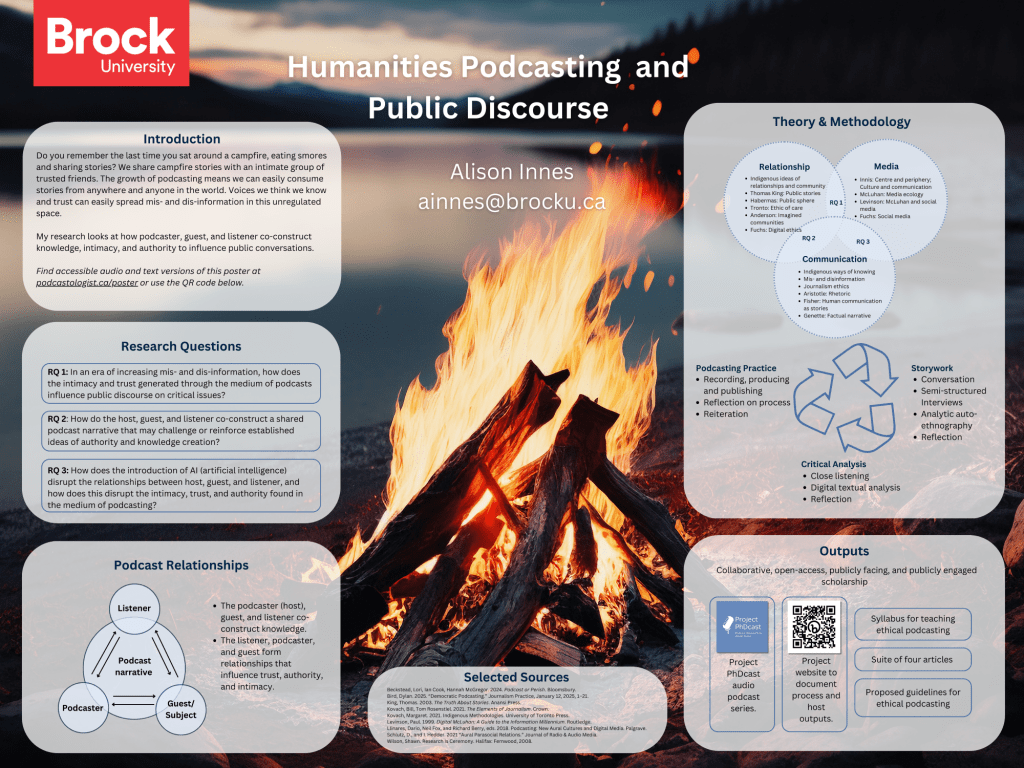
Do you remember the last time you sat around a campfire, eating smores and sharing stories? We share campfire stories with an intimate group of trusted friends. The growth of podcasting means we can easily consume stories from anywhere and anyone in the world. Voices we think we know and trust can easily spread mis- and dis-information in this unregulated space.
My research looks at how podcaster, guest, and listener co-construct knowledge, intimacy, and authority to influence public conversations.
Research Questions
RQ 1: In an era of increasing mis- and dis-information, how does the intimacy and trust generated through the medium of podcasts influence public discourse on critical issues?
RQ 2: How do the host, guest, and listener co-construct a shared podcast narrative that may challenge or reinforce established ideas of authority and knowledge creation?
RQ 3: How does the introduction of AI (artificial intelligence) disrupt the relationships between host, guest, and listener, and how does this disrupt the intimacy, trust, and authority found in the medium of podcasting?
Podcasting Relationships
My diagram will map how the the listener, podcaster, and guest co-construct knowledge that may either challenge or reinforce established beliefs. This will take into consideration how intimacy, trust, and authority are constructed in these parasocial relationships and how the unequal power dynamics might shape a particular narrative.
Theories
Relationships
- Indigenous ideas of relationships and community
- Thomas King: Public stories
- Habermas: Public sphere
- Tronto: Ethic of care
- Anderson: Imagined communities
- Fuchs: Digital ethics
Communication
- Indigenous ways of knowing
- Mis- and disinformation
- Journalism ethics
- Aristotle: Rhetoric
- Fisher: Human communication as stories
- Genette: Factual narrative
Media
- Innis: Centre and periphery; Culture and communication
- McLuhan: Media ecology
- Levinson: McLuhan and social media
- Fuchs: Social media
Methodologies
Storywork
Drawing on Indigenous methodologies, I will go beyond formal interviews to engage reflectively with fellow Humanities podcasters. By using a relational approach, my research will be formed by and contribute back to the podcasting community.
Podcasting Practice
I will use my podcast as an open source critical autoethnography. I will document my experiences, share my storywork, and mobilize my research in real time. My practice will be informed by my research and will also help identify new and interesting problems.
Critical Analysis
I will use close listening and digital text analysis tools on selected podcasts to critically analyze podcast discourse. This analysis will consider how a particular podcast might influence, or be influenced by, public discourse.
Outcomes
I will create open-access, publicly facing, and publicly engaged scholarship that collaborates with, responds to, and supports the development of the indie podcasting community while expanding the field of podcast studies.
- Proposed guidelines for ethical podcasting
- Syllabus for teaching ethical podcasting
- Suite of four articles
- Project website to document process and host outputs
- Podcast series to document research process and outcomes
Selected Sources
Beckstead, Lori, Ian Cook, Hannah McGregor. 2024. Podcast or Perish. Bloomsbury.
Bird, Dylan. 2025. “Democratic Podcasting.” Journalism Practice, January 12, 2025, 1–21.
King, Thomas. 2003. The Truth About Stories. Anansi Press.
Kovach, Bill, Tom Rosenstiel. 2021. The Elements of Journalism. Crown.
Kovach, Margaret. 2021. Indigenous Methodologies. University of Toronto Press.
Levinson, Paul. 1999. Digital McLuhan: A Guide to the Information Millennium. Routledge.
Llinares, Dario, Neil Fox, and Richard Berry, eds. 2018. Podcasting: New Aural Cultures and Digital Media. Palgrave.
Schlutz, D., and I. Hedder. 2021 “Aural Parasocial Relations.” Journal of Radio & Audio Media.
Wilson, Shawn. Research Is Ceremony. Halifax: Fernwood, 2008.
Credits
Project PhDcast is created, hosted, and produced by Alison Innes. Music is “Grand Dark Waltz” by Kevin McLeod (incomptech.com) and is used under Creative Commons license.
View this podcast with subtitles on YouTube. Transcripts available for download by request.
Share your thoughts:
- Visit my website https://podcastologist.ca/contact
- Email podcastinghumanities@gmail.com
- Learn more about this research project and how you can participate by visiting https://podcastologist.ca
Project PhDcast is an ongoing project by Alison Innes, PhD student in Interdisciplinary Humanities at Brock University. This research project has been approved by the Research Ethics Board at Brock University, file #23-020-MAURO.

 Project PhDcast
Leave a comment