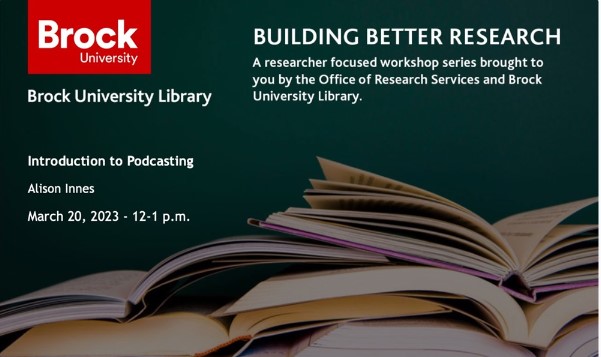
Building Better Research: Introduction to Podcasting
Alison Innes
Brock University
March 20, 2023
12 noon to 1 p.m. Online.
Podcasting has become a popular way of translating complex, cutting-edge research into communication that can be easily understand by non-experts and disseminating that information to non-expert communities. Drawing on my own experience and research as both an independent podcaster with MythTake from 2016-2020 and as a university-based podcaster with the Faculty of Humanities’ Foreword (2020-present), this workshop will explore some of the unique opportunities offered by this medium.
Accessibility: The accessible nature of podcasts works on several levels: They are technologically easy to produce with equipment that is readily available and they are openly accessible to listeners. The low barrier to entry and their accessibility provides a unique space for scholars to engage the public in specialized topics.
Responsiveness: Podcasts can be produced and distributed quickly, making them a useful tool for responding to current events or research developments. Online distribution allows listeners from anywhere in the world to access episodes immediately. Podcasting can be used throughout a project to demystify academic research and share the research process with listeners.
Intimacy: Episodes are listened to in intimate settings, providing a hyper-intimate experience for both listener and creator (Berry 2016). The listener hears the researcher talk about their work using personal speech patterns, accents, and combinations of technical and colloquial phrases. The shift to listening on smartphones allows listeners to extend the experience into social media by engaging with the fan community.
Flexibility: Podcasts are flexible in both form and use, allowing them to be shaped to meet the needs of both podcaster-researcher and listener. They can be used in multiple, overlapping ways in the university: teaching, marketing, and sharing information about services and technology are all mobilized through podcasts (Harris and Park 2008). A podcast with the primary goal of knowledge mobilization can also be used to help with recruitment, to supplement a lecture discussion, and to foster collaboration and relationship building between faculty.
Podcasting is not without its challenges. For example, podcasts require a great deal of work to create and maintain and some researchers may be reluctant to engage with what they see as an unfamiliar or risky medium. However, as a flexible, accessible, intimate, and immediate medium, podcasts can provide researchers with a powerful way to disseminate knowledge.


 Project PhDcast
Leave a comment